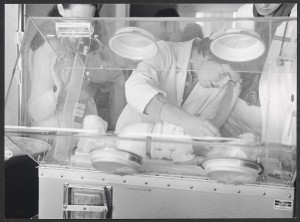
In an interview a few years ago, Paul Farmer, the co-founder of Partners in Health and arguably one of our most effective communicators about obstacles to social justice and global health at the grandest scale, posited that the largest of those obstacles relates not to what we know about effective technologies, but to our ability to deliver them to patients. The coming revolution, he suggested, would be driven by this “third D” – Delivery – and progressively less by the other Ds, Discovery and Development. Farmer was thinking about extreme disadvantage in predominantly under-resourced settings, but I was fascinated by how clearly he had articulated the central problem in our own, highly privileged and technologically-advanced field.
The Three Ds (and their other formulation, the “clinical and translational research spectrum“) do not just describe a range of investigation; they also trace the dominant activities in our field over time. Over the past several hundred years, progress in medicine has typically started with epiphanies of basic or observational science by those archetypal white-coated (or, before that, be-wigged) scientists who populate old movies. The most prominent examples are the basso continuo of our pre-clinical medical school reading: William Harvey’s description of the circulation; Anton van Leeuwenhoek and the discovery of blood cells; Louis Pasteur and germ theory; Alexander Fleming’s accidental discovery of penicillin; Edward Jenner’s connecting of cowpox to prevention of smallpox; Jonas Salk and the cataloguing of polio virus, James Watson, Francis Crick and Rosalind Franklin and DNA. The classic neonatology-specific example is the work of John Clements, whose painstaking measurements of surface tension and identification of surfactant, subsequently confirmed to be the cause of respiratory distress syndrome by Mary Ellen Avery, are the foundations for our field.
Such laboratory advances have continued at an accelerated pace, but much of the music of the twentieth century involved understanding how basic mechanisms could be safely and reliably translated into interventions that directly improve health. There had been earlier examples, of course, like William Morton’s “Gentleman, This is No Humbug” use of anesthesia in 1846. But the most powerful advances came along with the evolution of rigorous study design, particularly the randomized controlled trial introduced by Austin Bradford Hill in the 1940s. Within a few years of Hill’s first RCT, Jonas Salk had employed the approach with an audacious, partially randomized trial of the inactivated polio vaccine in schoolchildren, and evidence-based pediatrics was on its way.
“…even as we rack up successes,
the failures to apply what we know
become more dramatic”
Newborns and infants have benefitted disproportionately from Discovery and Development. Deaths from diphtheria, mumps, pertussis and tetanus decreased by 99% following vaccine introduction. Tetsuro Fujiwara’s exogenous surfactant, building on the discoveries of Avery and Clements, decreased infant mortality by more than half in only a few years. Some of the earliest randomized trials were completed in newborns, and the Cochrane Neonatal Review Group was founded third of some 53 currently operating worldwide.
So why do we need a Delivery Revolution in neonatology? The problem is that, even as we rack up successes, the failures to apply what we know become more dramatic. Globally, 44% of the 6.3 million annual under-5 deaths are still in the neonatal period, mainly from prematurity, pneumonia and intrapartum complications. Here in the US, prematurity-related infant mortality rates for African-Americans are 3.9 times those of white babies. When we have efficacious therapies, we don’t necessarily choose to use them: even after more than 3,000 pregnancies were enrolled in RCTs consistently showing antenatal corticosteroids to be safe and effective, fewer than 40% of eligible women were receiving them. Enormous interinstitutional variability has been documented repeatedly, as for example in the Vermont Oxford Network, where 25% of units in 2008 used early CPAP in fewer than 1/3 of their babies, while 25% used it in 3/4 of patients. Finally, it is no secret that this inconsistency is seen in a US health care system that costs 50% more than the next runner in the pack.
I freely admit to being a trials nerd, and it is crucial that we continue to examine efficacy results from rigorous studies, as is reported in the other excellent blogs that I read religiously (here and here – sign up if you are one of the few who haven’t already), and to keep our eyes open for more of those early stage laboratory insights that fuel them. But those efforts, and the huge research resources that are invested to generate them, will be wasted if we don’t get them to the bedside. Tools and research approaches are available, but less widely discussed and poorly funded in neonatology. We’ll talk about them here: health services and population research, research strategy and policy, implementation science, health economics, global and domestic health policy, and whatever else we can collectively identify as impediments to infant health. I’ll lead with my own observations, but please consider this an invitation to a vigorous conversation…
 Delivering Newborn Care